
Introduction: A New Era of Threat Demands a New Kind of Defense
Public sector cybersecurity is at a turning point. For decades, local governments operated under the assumption that their modest digital footprints made them unlikely targets. That assumption has been shattered.
Today, U.S. county governments are among the most aggressively targeted organizations in the country. They hold enormous volumes of sensitive citizen data, including Social Security numbers, property and tax records, court documents, health information, and voter registrations. They run critical public infrastructure. And in most cases, they are protected by IT teams of two to five people managing everything from printer support to network security.
The mismatch between the scale of the threat and the size of the defense team has created a vulnerability that cybercriminals are actively exploiting. According to CISA and Recorded Future, local governments experienced more ransomware attacks than any other public sector vertical in 2023. The average ransom demand for a government entity reached $2.07 million (Sophos State of Ransomware in Government, 2023).
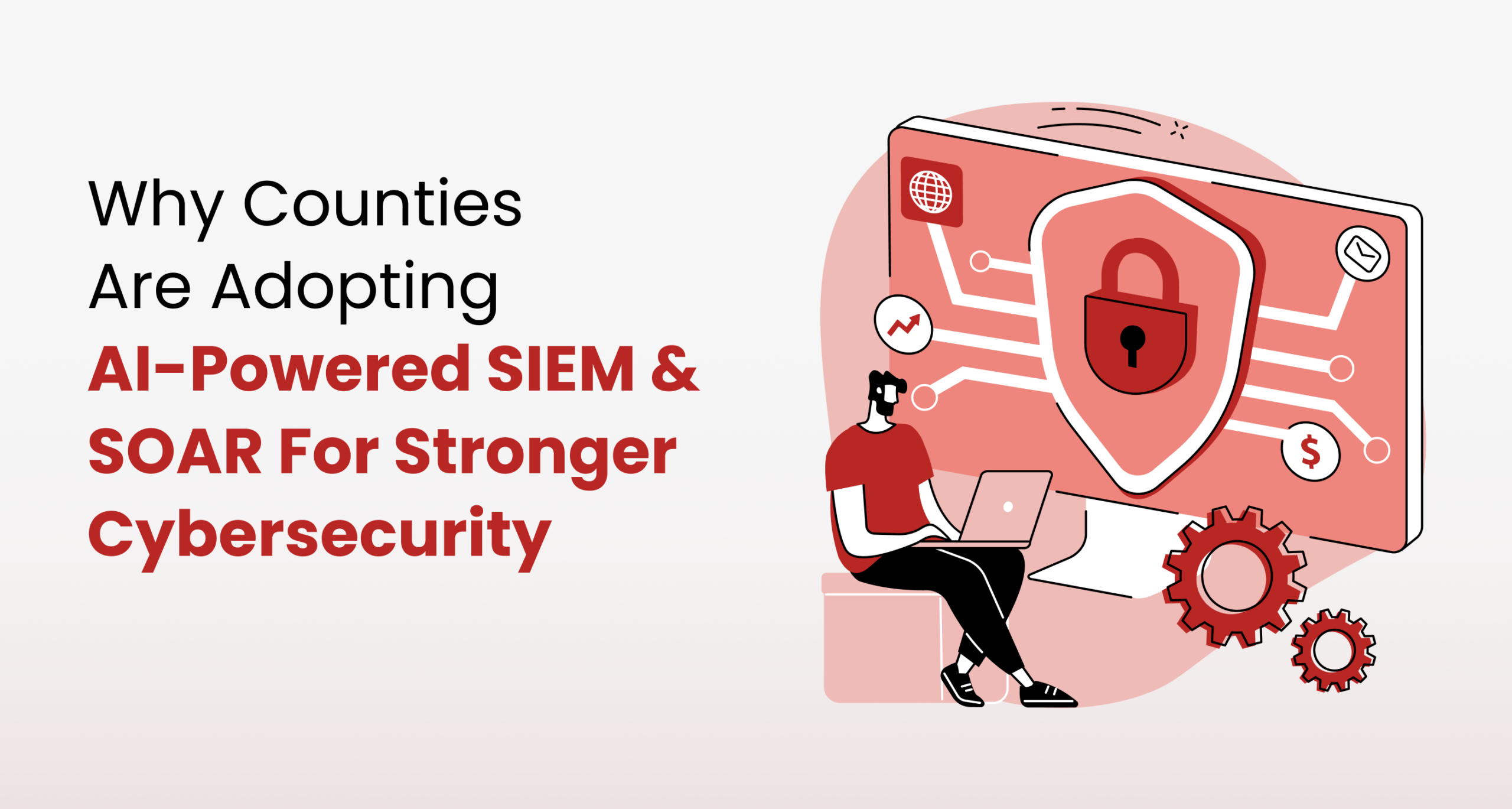
Something has to change. And across the country, forward-thinking county governments are finding the answer in AI-powered SIEM (Security Information and Event Management) and SOAR (Security Orchestration, Automation, and Response).
The Public Sector Cybersecurity Gap: Why Counties Are So Vulnerable
To understand why AI-powered SIEM and SOAR matter so much for county governments, it helps to understand the specific conditions that make the public sector uniquely exposed.
Lean IT teams with no 24/7 security coverage. Most counties simply do not have dedicated cybersecurity staff. The same person managing Active Directory in the morning may be handling desktop support in the afternoon. Threat actors know this, and they time their attacks accordingly. The majority of ransomware deployments targeting local governments are triggered late at night or on weekends, when nobody is watching.
Legacy infrastructure that was never built for modern threats. Many county government systems were designed and implemented years before cloud computing, mobile access, or modern threat actors existed. Aging on-premise servers, unpatched operating systems, and disconnected security tools leave enormous gaps in visibility that sophisticated attackers readily exploit.
Compliance mandates that keep growing. County governments are required to comply with CJIS (Criminal Justice Information Services) for law enforcement data, HIPAA for county health departments, PCI-DSS for tax and fee payment portals, and an expanding list of state-level cybersecurity regulations. Meeting all of these simultaneously without automated tooling is a near-impossible burden for small IT teams.
High-value data with limited perimeter protection. Citizen data is extraordinarily valuable to cybercriminals. A single county may hold the personally identifiable information of hundreds of thousands of residents, all accessible through a network that may have no behavioral monitoring, no real-time alerting, and no automated incident response capability.
These conditions do not exist because county governments lack commitment to security. They exist because the tools available for decades were simply not designed for the way county IT operates.
What Are SIEM and SOAR, and Why Do They Work Together?
Before exploring why AI-powered SIEM and SOAR are becoming the standard for public sector cybersecurity, it is worth clarifying what these technologies actually do and why their combination is so powerful for county governments.
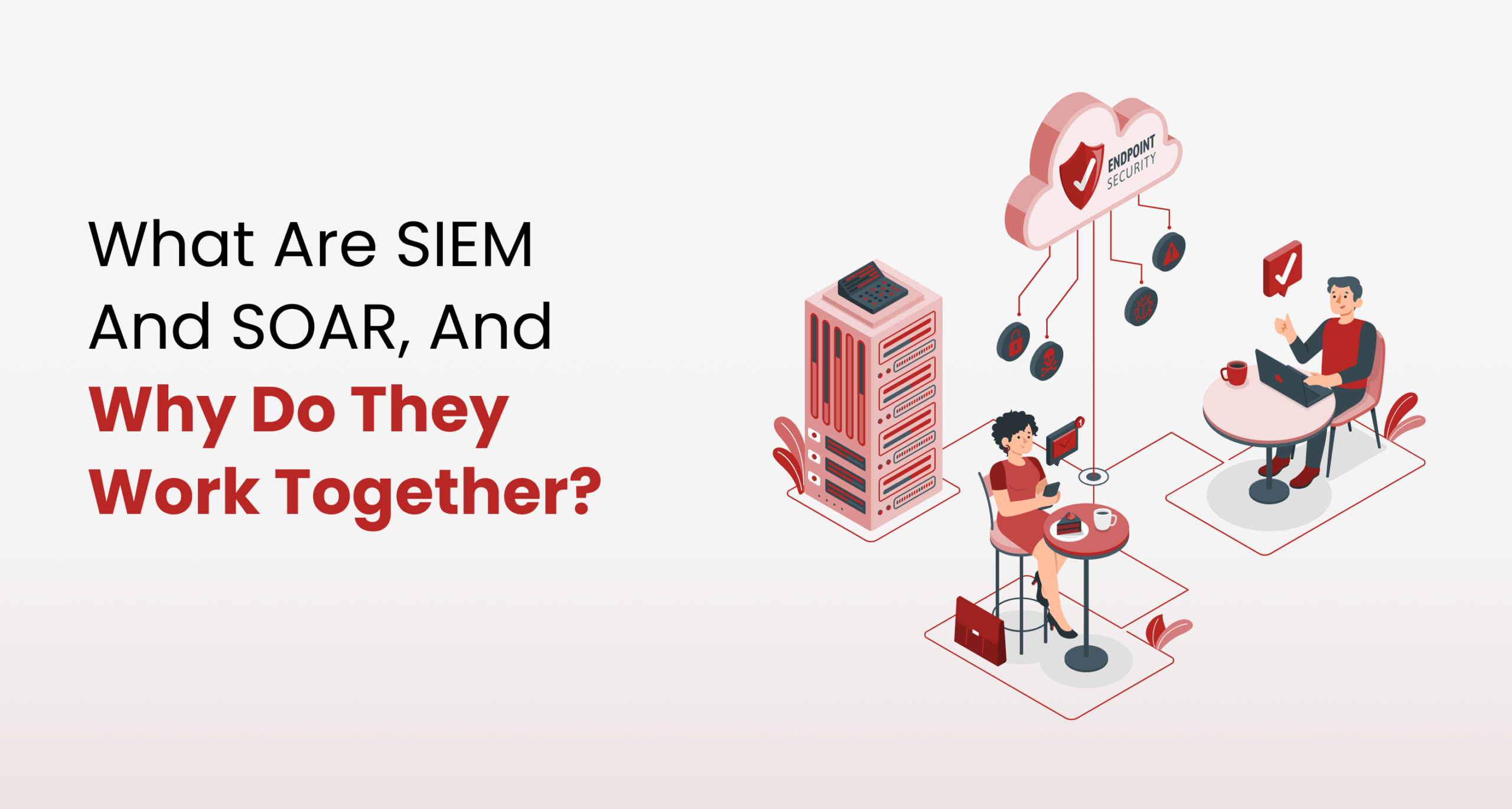
SIEM (Security Information and Event Management) is a platform that collects, aggregates, and analyzes log and event data from across an organization’s entire IT environment. Every login attempt, file access, network connection, and system change generates a log. SIEM pulls all of that data together into a unified view, applies correlation rules and analytics to identify suspicious patterns, and alerts security teams when something looks wrong.
Traditional SIEM platforms did this reasonably well in large enterprise environments staffed with trained analysts. But they generated enormous volumes of alerts, required constant tuning, and demanded expert human interpretation to separate genuine threats from false positives. For a county with two IT generalists, that model was unworkable.
AI-powered SIEM transforms this equation. Instead of relying on static, manually written rules, AI-powered SIEM uses machine learning and behavioral analytics to establish dynamic baselines for every user, device, and system. When behavior deviates from those baselines, the platform identifies the anomaly, scores it by risk severity, and surfaces only the alerts that truly warrant attention. Alert fatigue drops by as much as 80 percent. The platform gets smarter over time.
SOAR (Security Orchestration, Automation, and Response) takes the output of SIEM and acts on it automatically. When AI-powered SIEM identifies a confirmed threat, SOAR executes pre-built response playbooks without waiting for human intervention. It can isolate a compromised endpoint, revoke a stolen credential, block a malicious IP address, trigger a ticket in the IT service management system, and notify the relevant stakeholders, all within seconds. For county governments where no one may be actively monitoring the security console at 2 AM, SOAR is the difference between a contained incident and a full-scale breach.
Together, AI-powered SIEM and SOAR give county governments the continuous detection and automated response capability of an enterprise security operations center, without requiring an enterprise-sized team to run it.
The Threat Landscape Facing U.S. County Governments in 2025
Understanding what AI-powered SIEM and SOAR are defending against makes their value concrete. The threats facing county governments are not theoretical. They are active, evolving, and increasingly well-funded.
Ransomware remains the dominant threat. Ransomware groups have deliberately shifted their targeting toward local governments because counties are more likely than corporations to pay ransoms quickly in order to restore public services. Suffolk County, New York spent over $25 million recovering from a 2022 ransomware attack. Dallas County, Texas was hit in 2023. These attacks do not just cost money; they disrupt public services that citizens depend on for their daily lives.
Phishing and credential theft are the most common entry points. County employees across departments, including clerks, assessors, finance teams, and public health staff, receive millions of phishing emails every year. A single successfully stolen credential can give a threat actor unrestricted access to county financial systems, citizen databases, or Active Directory, where they can create new accounts and elevate privileges at will.
Supply chain and third-party vendor attacks are increasing. Counties rely on dozens of software vendors for property tax systems, permitting platforms, court case management, and payment processing. Each vendor integration is a potential entry point. The MOVEit vulnerability in 2023 exposed dozens of government organizations through a single third-party file transfer tool, demonstrating how supply chain risk cascades across entire counties and regions.
IoT and operational technology vulnerabilities are underprotected. Modern counties operate extensive connected infrastructure including traffic management systems, water and wastewater SCADA networks, building automation, and public safety IoT devices. These systems often run on legacy protocols with no native security monitoring, making them attractive targets for threat actors looking to cause operational disruption.
Insider threats are persistent and underestimated. High staff turnover in local government creates a constant cycle of credential management challenges. Departed employees with still-active accounts, overprivileged contractors, and disgruntled insiders represent threats that perimeter security tools alone cannot address.
Why AI-Powered SIEM and SOAR Are the Right Answer for Counties
The shift toward AI-powered SIEM and SOAR in the public sector is not a trend driven by vendor marketing. It is a practical response to a real problem. County governments that have deployed these technologies report meaningful improvements across detection speed, response time, compliance readiness, and operational cost.
Real-time behavioral threat detection without analyst overhead. AI-powered SIEM monitors every user session, network connection, and system event continuously, building behavioral models that flag deviations the moment they occur. A user accessing unusual files at midnight, a service account making unexpected lateral connections, or a sudden spike in outbound data transfer all trigger automatic analysis and alert prioritization. County IT teams receive a focused, prioritized queue of genuine threats rather than a flood of noise.
Automated response that operates around the clock. SOAR playbooks execute automatically when a threat is confirmed, meaning the county’s security posture does not degrade after business hours. Compromised accounts are locked. Malicious traffic is blocked. Affected systems are quarantined. And the full incident timeline is logged and preserved for compliance reporting, all without requiring a human to be awake and actively watching.
Unified visibility across every environment. Modern county governments operate across a mix of on-premise servers, cloud services, hybrid environments, and legacy systems. AI-powered SIEM aggregates data from all of these sources into a single security data lake, giving IT teams a complete and current picture of everything happening across the environment. There are no blind spots for attackers to hide in.
Built-in compliance automation. AI-powered SIEM continuously maps security events and audit activity to the specific compliance frameworks county governments must satisfy, including CJIS, HIPAA, PCI-DSS, GLBA, DFARS, and GDPR. Audit trails are generated automatically. Compliance reports are available on demand. This transforms what was previously a weeks-long manual effort into an automated, always-current output.
Predictable cost with no data ingestion limits. Traditional SIEM platforms charge based on the volume of data ingested, a model that punishes organizations as their environments grow. For county governments operating on fixed budgets approved by commissioners, unpredictable security costs are a serious challenge. Modern AI-powered SIEM platforms like SmiForce offer fixed pricing with no data ingestion limits, making it possible to monitor everything without worrying about cost spikes.
How SmiForce Is Purpose-Built for Public Sector Cybersecurity
SmiForce, headquartered in Eden Prairie, Minnesota and founded in 2010, is a minority-owned cybersecurity company that has built its AI-powered SIEM and SOAR platform with exactly this use case in mind. The platform was designed for organizations that need enterprise-grade security without an enterprise-sized security team, making it a natural fit for U.S. county governments.
SmiForce integrates seamlessly with the infrastructure that counties already use. On the network side, it connects with Cisco, Palo Alto Networks, Fortinet, Aruba, and Zscaler. For infrastructure, it monitors VMware environments, Microsoft Active Directory, AWS CloudTrail, Azure Monitor, and standard Linux and Windows server logs. For applications, it pulls event data from Microsoft 365, Google Workspace, ServiceNow, SAP ERP, and Salesforce. For IoT environments, it connects with Cisco IoT Control Center, AWS IoT Core, Azure IoT Hub, and industrial IoT platforms from Siemens and PTC.
This breadth of integration means SmiForce provides genuine visibility across the full county environment, not just the parts that happen to be covered by a particular tool.
The platform is delivered as a fully managed service. SmiForce handles deployment, configuration, ongoing tuning, threat monitoring, and support. County IT teams gain the benefit of continuous expert-level security operations without needing to hire, train, or retain dedicated security analysts. The white-glove service model is especially important for counties where the IT director is also responsible for infrastructure, helpdesk, and end-user support.
The Federal Momentum Behind Public Sector AI Security Adoption
The shift toward AI-powered cybersecurity in local government is not happening in isolation. Federal agencies and policymakers are actively driving this transition through frameworks, mandates, and funding programs.
CISA’s Cybersecurity Performance Goals provide a structured set of baseline security practices that local governments are expected to implement. These goals emphasize continuous monitoring, incident detection, and automated response capabilities, all of which align directly with what AI-powered SIEM and SOAR deliver.
The State and Local Cybersecurity Grant Program, funded through the Infrastructure Investment and Jobs Act, has allocated hundreds of millions of dollars specifically to help county and municipal governments upgrade their cybersecurity posture. Counties that deploy solutions meeting CISA’s performance goals are well-positioned to access this funding, which can offset implementation costs significantly.
The Executive Order on Improving the Nation’s Cybersecurity, originally issued in 2021 and reinforced through subsequent guidance, has created a broader cultural and policy expectation that all levels of government will adopt modern, AI-driven security operations. Counties that act now are not just protecting their citizens. They are aligning with the direction that federal policy and funding are clearly headed.
What the Future Looks Like for County Cybersecurity
The trajectory for public sector cybersecurity is clear. Threats will continue to grow in sophistication and frequency. Compliance requirements will keep expanding. And the expectation from citizens, federal agencies, and state governments is that local government will maintain a credible, modern security posture.
Counties that rely on reactive, legacy approaches will face increasing exposure, higher breach costs, and growing difficulty qualifying for federal cybersecurity funding. Counties that invest in AI-powered SIEM and SOAR will be able to detect and respond to threats before they become crises, demonstrate compliance continuously, and operate a security program that scales with their environment rather than against it.
The future of public sector cybersecurity is not about hiring more analysts or buying more tools. It is about deploying intelligent, automated platforms that do more with fewer resources and make every county, regardless of size, capable of defending against the threats that are coming regardless.
Getting Started: What County Leaders Should Do Today
County IT directors, CIOs, and elected officials responsible for technology oversight have a clear path forward.
Start with an honest assessment of current visibility. Can your team detect unusual login activity after hours? Can you identify lateral movement inside your network? Can you demonstrate to auditors that your CJIS and HIPAA controls are operating continuously? If the answer to any of these is uncertain, the gap is real.
Map your compliance obligations to your current tooling. Identify where your existing security tools leave compliance requirements uncovered. SIEM and SOAR platforms that automate compliance mapping close these gaps automatically and reduce the manual burden on your team.
Prioritize managed solutions over self-operated platforms. Given the staffing realities of most county IT departments, fully managed AI-powered SIEM is not just more convenient. It is the only realistic way to achieve continuous security coverage without adding headcount that most counties cannot budget for.
Engage with available federal funding. Before making any security investment decision, explore what State and Local Cybersecurity Grant Program funding your county may be eligible for. The right AI-powered SIEM deployment could be substantially offset by grant resources already allocated for exactly this purpose.
Request a demo before committing. The clearest way to understand what AI-powered SIEM and SOAR can do for your county is to see the platform working against a realistic model of your environment and threat profile. A 15-minute demo is a low-cost starting point with meaningful potential upside.
Conclusion: The Window to Act Is Open, but It Will Not Stay Open
County governments across the United States are standing at a genuine inflection point. The threat environment has evolved faster than most local government security programs. The tools to close that gap now exist and are more accessible than ever. Federal funding is available to help pay for them. And the cost of waiting grows with every month that passes without action.
AI-powered SIEM and SOAR are not the future of public sector cybersecurity. They are the present. The counties already deploying them are detecting threats faster, responding in seconds rather than days, and building the compliance documentation that protects them from regulatory risk. The counties that have not yet made the move are carrying exposure that one successful ransomware attack can turn into a $2 million crisis.
SmiForce was built to make that choice easy. With a fully managed platform, fixed predictable pricing, no data ingestion limits, and integration with the systems your county already uses, SmiForce gives every county government the AI-powered security operations capability it needs to protect its citizens, its infrastructure, and its future.
Ready to See AI-Powered SIEM and SOAR in Action?

Book a 15-minute demo with the SmiForce team and see how AI-powered SIEM and SOAR can work for your county’s specific environment, compliance needs, and budget.
Website: www.smiforce.com Email: sales@smiforce.com
SmiForce is a minority-owned cybersecurity company headquartered in Eden Prairie, Minnesota. Founded in 2010, SmiForce provides AI-powered SIEM, SOAR, and Data Analytics as a Service solutions to public sector organizations, enterprises, SMBs, and educational institutions across the United States.